We all know that collimating a telescope that has multiple curved mirrors is Black Magic. I’ve tried it and I can happily confirm I am… not a witch.
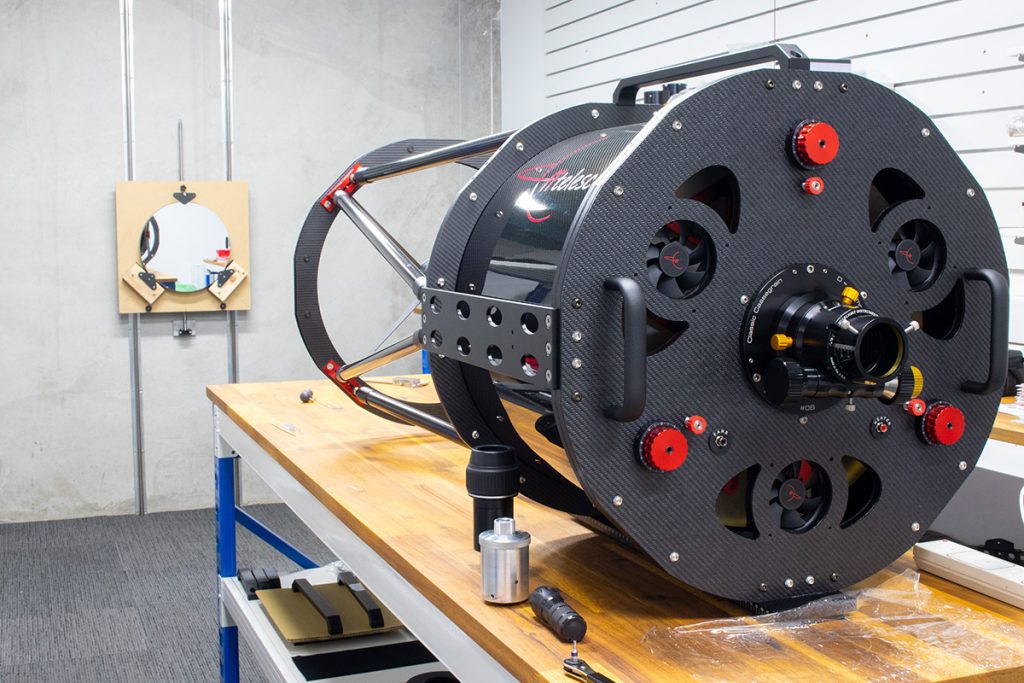
Here’s a 400mm f/20 Classic Cassegrain. The primary mirror is a parabola and the secondary is a hyperbola. And if you do the maths, the focal length really is 8000mm!
The last stage of manufacturing for this monster was collimation. To do this, Catalin (definitely a wizard) set it up on a bench so it was facing a flat mirror on the wall opposite. Using an artificial star and a beam splitter, he sent a beam of light from the eyepiece, bouncing off the secondary, back to the primary, out to the flat mirror, back to the primary, then the secondary and through the beam splitter to the eyepiece. This allowed him to align the telescope on the bench first, and then to adjust the mirrors.
The scope has now been crated up and shipped off to its new owner in Europe.