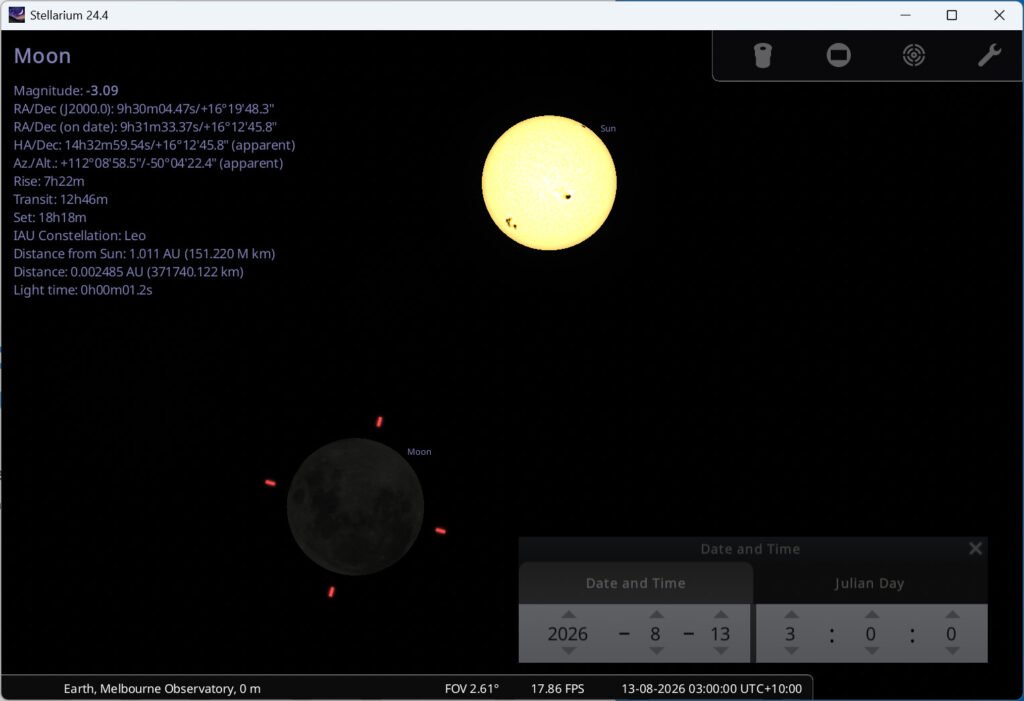
This week (mid-August 2026) there was a total solar eclipse in Spain (plus a bit of Iceland and Greenland). Sadly, without travelling, the image here is the best we were able to get.
Eclipses are terrifying
Eclipses are a very significant part of human culture, having been seen as an omen, mostly evil, by nearly every civilisation. Because of this importance, the greatest minds of those societies spent an awful lot of time trying to understand what was going on. The ultimate goal was to predict an eclipse ahead of time. The knowledge to accurately predict an eclipse would give a leader immense persuasive power, as in literally making your enemy’s soldiers quake in their sandals.
(Some) eclipses are predictable
After centuries of careful recording of dates, astronomers (or more accurately, astrologers) discovered that some eclipses tended to follow others by one specific interval. This cycle became known as the Saros Cycle. At the time, the astrologers didn’t know why this happened, but it was enough to know that it did.
The Saros Cycle is 18 years, 11 days and 8 hours.
Why is this?
For a solar eclipse to happen, two critical conditions have to all be met. These are:
- Solar declination has to equal the lunar declination (this is the latitude on earth where the sun and moon is directly overhead). That is, the sun and Moon have to be on the same plane as seen from the Earth.
- The Moon is new (that is, the sun, Earth and Moon are in a straight line in space).
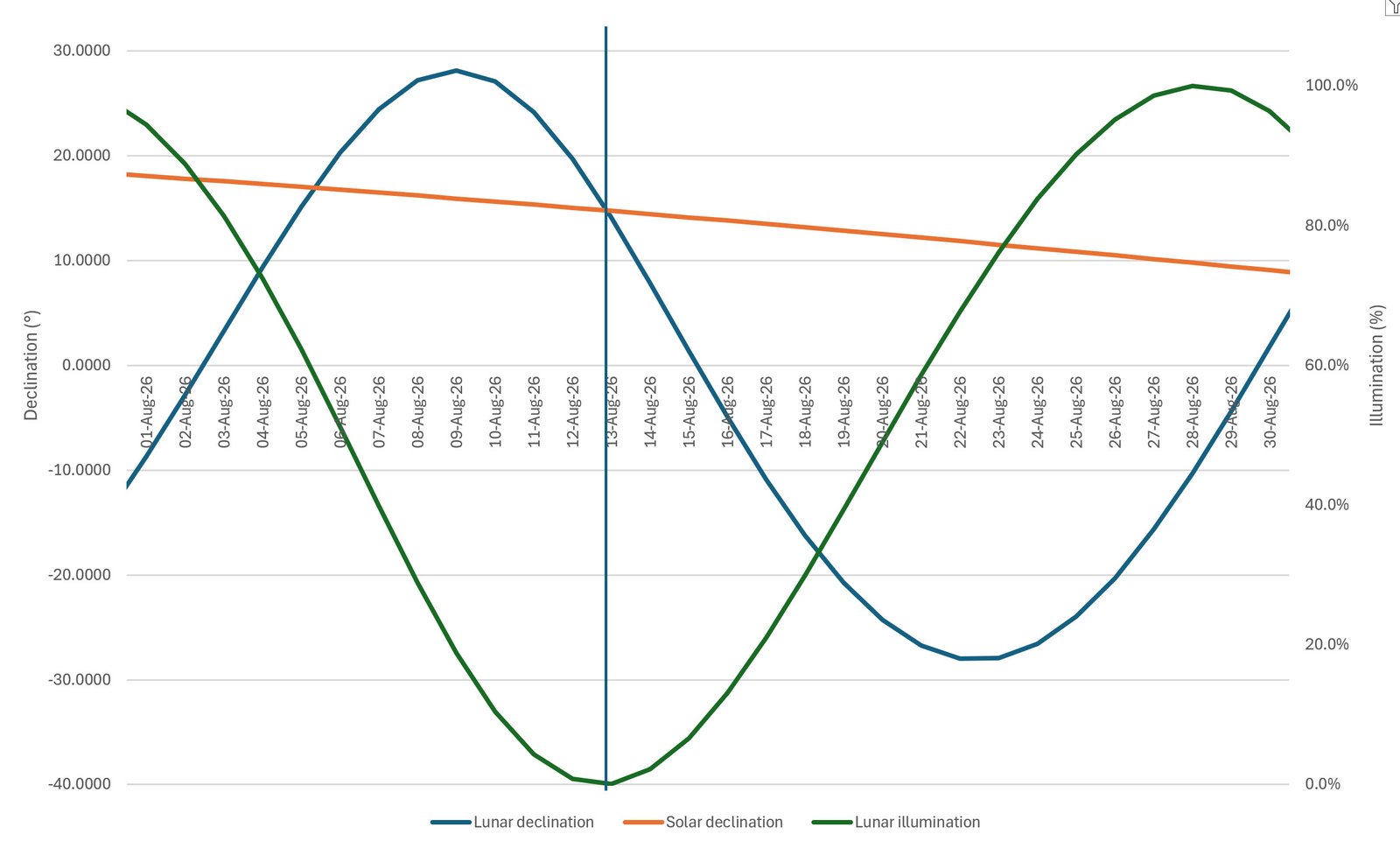
The graph here shows all these things.
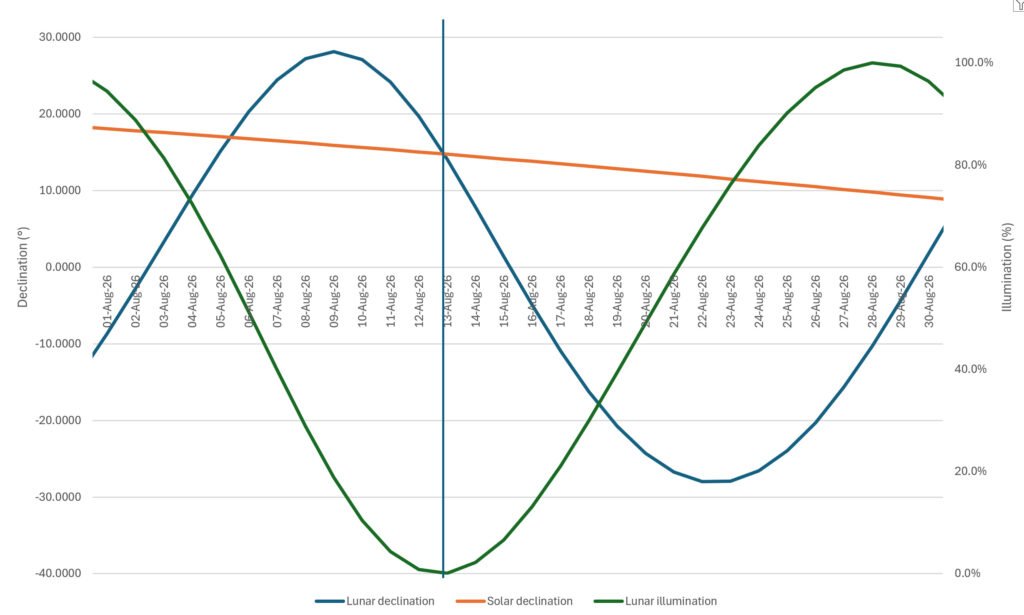
The orange line shows the declination of the sun. You can see that in mid-August it is about 15° north of the Earth’s equator. The sun returns to the same declination four times in four years (taking leap years into account as well as some other minor factors).
The blue line shows the declination of the Moon. The Moon returns to the same declination every 27.21 days. This rejoices in the magnificent name of a draconic month.
The green line shows lunar illumination. This has a cycle of 29.53 days. This one is called a sydonic month.
And there it is!
Near sunset on 12 August (that’s GMT, remember) you can see all three of these conditions were met. Chance for a solar eclipse?
Nearly! There’s one extra condition. The distance between the Moon and the Earth also has to also be right, or the geometry doesn’t work. The period between one Lunar perigee and the next is 27.55 days, or one anomalistic month.
Do the maths and you’ll find that 223 synodic months, 242 draconic months and 239 anomalistic months are all 6585.3 days. This is one Saros Cycle.
Who’s quaking now?
Obviously, the whole story is a lot more complicated than this. There are a whole pile of factors that make the difference between a solar eclipse and a plain new Moon. Those differences could well have meant that rather than the enemy’s soldiers, it’s the court astrologer who’s quaking in his sandals!