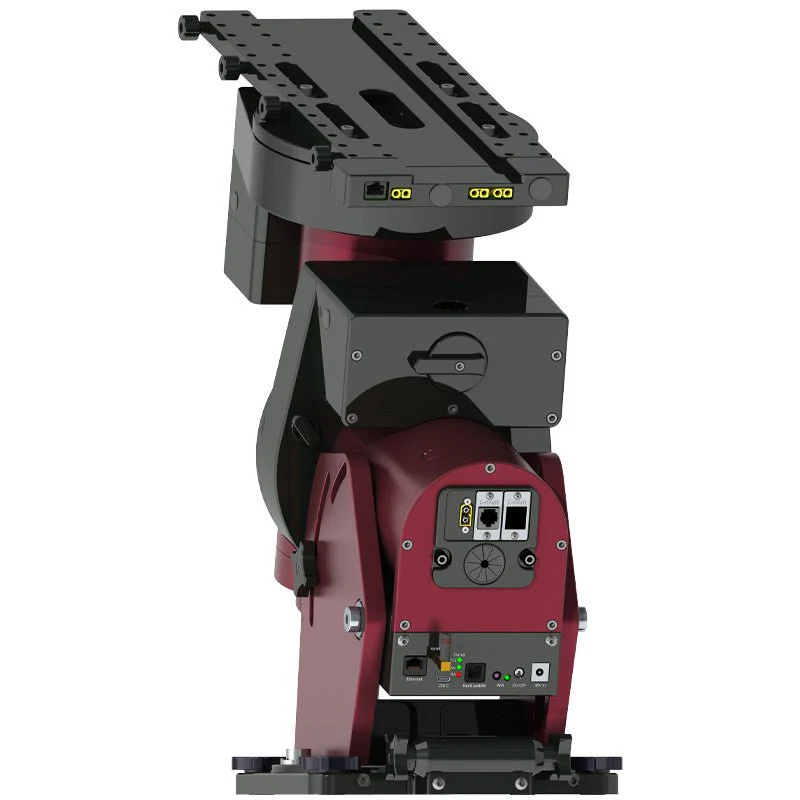
Now that Sidereal Trading is offering Paramount astrophotography mounts, we need to understand about the encoders that they use. Encoders are a way your mount can keep track of where it is pointing. Not just approximately, though. A high-resolution encoder will ensure your imaging computer knows precisely where the mount is pointing.
So, what is an encoder?
An encoder is gizmo that is able to measure movement (in our case, how much an axis has rotated) over time.
A simple example of an encoder (and one that we work with) is the one on a ScopeDome rotation motor. It’s simply a slotted cog like the daisy wheel from an old typewriter (remember those?). This goes onto the motor axle like a collar and rotates as the motor turns. A light source shines through the slots in the daisy wheel, and a sensor counts how many times it sees the light flash. From this, the computer can calculate how far the axle has rotated, and hence (pretty accurately) how far the dome has moved.
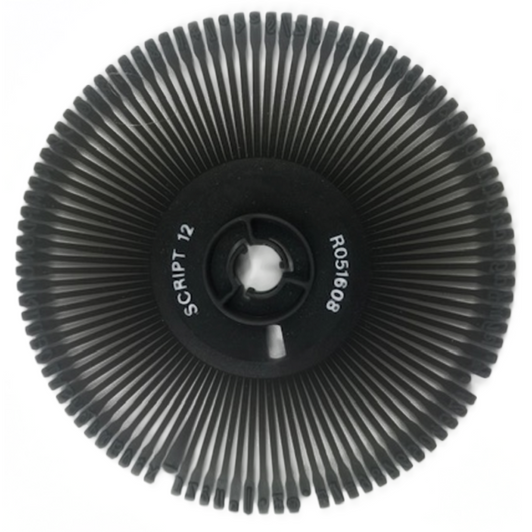
Of course, this is just the concept. The type of encoders used in astro mounts are much higher resolution than a simple daisy wheel. They work in different ways too, but the concept (like the song) remains the same.
At present, the alternative to an encoder is a stepper motor, which moves reliably a certain number of steps at a time. This is what you find on consumer-grade astrophotography mounts. Without an encoder to actually see how far the axle has moved, if the computer knows how many steps a full rotation is, it can estimate where the axle is. Of course, if you’re moving in less-than-whole steps, this turns into a bit of a guess.
Moving up the market to the professional end, Paramount mounts have servo motors and various kinds of encoders. These tell the mount (or the controlling computer) exactly where the mount is pointing. This acts as a data input into the “sky model” so the mount is always accurately tracking the target star. (Of course, there are other inputs, so for example, the mount can compensate for atmospheric refraction near the horizon, etc.).
There are encoders and there are encoders
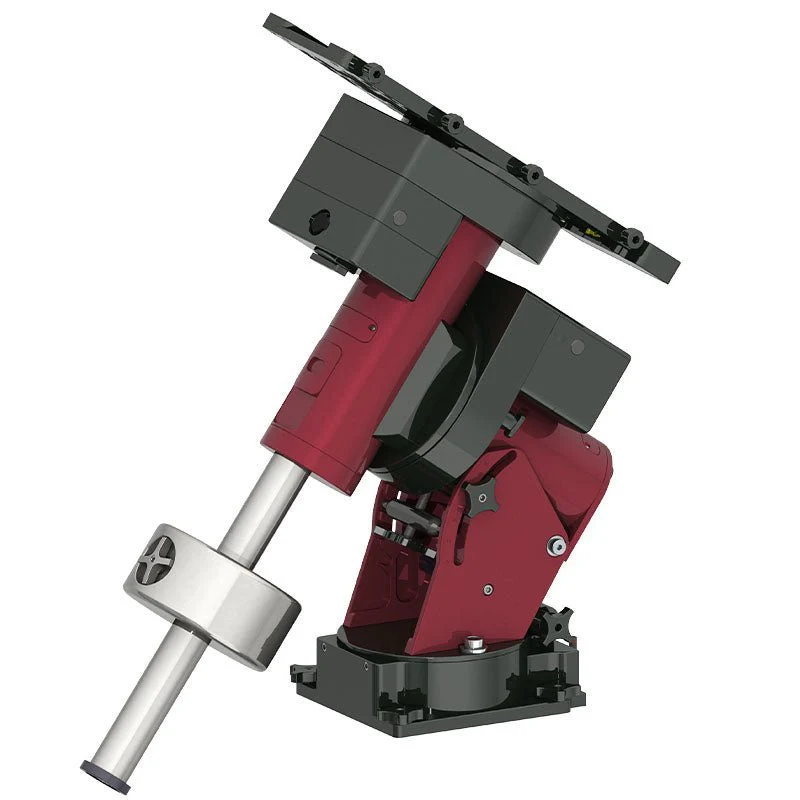
Paramount mounts can ship with two different types of encoder. There are a few differences, the most noticeable being price.
Incremental (motor-based) encoder
This type of encoder is located, like the ScopeDome encoder we discussed earlier, on the axle of the motor. It can see any little movements the motor makes.
- This type of encoder can’t know anything about your (inevitable) backlash. That’s because there’s a gap in the gears, or maybe a slight slump in a belt, and the motor can turn a little with no effect on the mount at all. Similarly, the encoder can’t compensate for imperfections in the gears in the drive train, including any periodic error you’ve got from having even the tiniest out-of-roundness in the gears, etc. You will probably have noticed you can manhandle your existing mount and wobble the axes back and forth a tiny fraction. A motor-based encoder won’t feel you doing this.
- This type of encoder doesn’t remember where it was last time the mount was on. For this reason, it has to be reset whenever the mount is turned on. Observatory-grade mounts have a “find home” feature that searches for a sensor. When this happens, the incremental encoder is set to zero and starts counting (up or down) from home.
On axis absolute encoder
An on-axis absolute encoder is located not on the motor or any of the gears, but on the final drive – the axis itself, meaning the physical RA or Dec axis of your mount.
- Because it’s on the axis, there are no effects like periodic error, backlash, belt tightness, etc.) to correct for – they’re all further back up the train. The encoder only sees what the axle is doing, not what the motor is doing.
- With the manhandling the backlash example above, on-axis encoder will know exquisitely what you’re doing (and will politely resist the urge to ask to you stop!).
- An absolute encoder knows where it is at all times, even when the mount or computer is cycled. It never needs homing.
- Sadly, this type of encoder also costs a boatload.
Do I need encoders? And if so, what type?
Obviously, we can’t answer that question for you. But let’s consider the extreme (hypothetical) case.
You have a remote observatory, hours’ drive away from your home. It has beautiful skies with exceptional seeing – that is, the stars don’t swim about while you’re imaging them. You have a big heavy scope with a very long focal length – let’s say it’s a 600mm f/20 Classic Cassegrain – with a focal length of 12 metres. You want to image dim, deep-sky galaxies, you’re going to oversample the hell out of them, and at f/20 you’re going to need 20-minute exposures (I told you this would be a hypothetical example!). This is a serious challenge in anyone’s book.
Physically, you can’t go there and nurse your mount when there’s a power failure. So, you need a home sensor – in reality, that’s a no-brainer for a remote observatory. But that 12 metres focal length, even the tiniest movement in your telescope is going to ruin your image.
Having high-resolution absolute encoders on your mount is going to ensure that the mount can keep your scope pointed at your target – perfectly. All mounts have a certain amount of backlash and periodic error. An absolute encoder can detect the actual, observed outcome of these errors. Because of this, it can tell your computer to manage the motors accordingly – in real time. PHD can only do this sort of thing only every 2-3 seconds. In that time the damage has been done.
With on-motor encoders, the mount can adjust for periodic error (after you’ve trained it), but backlash is back to being a problem, so your tracking isn’t going to be as accurate. PHD can catch backlash and drag your telescope back onto the target, but it’s still going to ruin an image at a long focal length. You can manage backlash, balancing (or possibly judicial unbalancing), and make other efforts such as only imaging on the east side of the meridian. Maybe you’ll get to as good a performance as the absolute encoders. And remember you need to home your mount every day.
To conclude
If your focal length isn’t stupidly long, and your seeing isn’t eye-wateringly perfect, you might decide to stick with the on-motor encoders.
But what happens when you get that night – that one night in a lifetime – where the seeing is as though the atmosphere doesn’t exist? Are you going to beat yourself up?
It’s your choice.
I think the bottom line is that if you have exquisite equipment, you’ll find you need the absolute encoders. Otherwise, your images won’t be extraordinary.