We’re about to see a nova!
Most of us know what a supernova is – a titanic bang that happens when a red giant collapses and explodes. But what’s a nova? A smaller version of the same thing?
Well, if the weather holds, you might be about to see one for yourself.
Low in the north in the evening (from Australia) is a smallish constellation called Corona Borealis – the Crown of the North. Near this constellation is a small, dim star called T Coronae Borealis (T CrB for short). But this star is anything but unremarkable. It’s called a “cataclysmic variable double star”. Awesome.
What’s going on?
A common red giant star is casually minding its own business – the business of getting old and losing its outer layers. These layers have formed an “accretion disk”, which looks like a plate of gas and dust that’s surrounding the star. But … there’s a white dwarf star that’s inserted itself into the accretion disk, and is gobbling it up.
The accretion layer steadily falls towards the surface of the hot white dwarf, and gathers in orbit around the star, getting heated more and more. Every 80 years or so, the whole build-up ignites in a massive nuclear fireball that last a week or so. Indications are that it’s about to go off any day now – probably in the next month.
Yes, this is going to be visible from the Earth. More than visible, the star will brighten from an invisible magnitude 10 to a bright magnitude 2 (about the same as the dimmer stars in the Southern Cross). So yes, you’ll see if – but only if you know where to look.
Go out at about 9pm and look towards the north-north-west. About 30° (a 30cm ruler held out at arm’s length) above the horizon you’ll see Arcturus, the brightest star in the vicinity. From here, move back to the right and down a fraction. If you’re in a dark sky area you should see an upside-down U-shaped constellation. T CrB is at the right end of this.
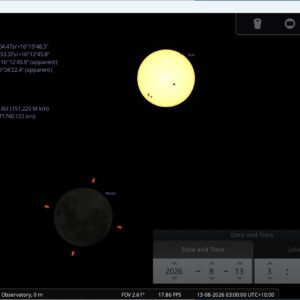
When the nova goes off, it won’t be as bright as Arcturus, but it will be brighter than the brightest star in Corona Borealis. Here’s a link to Stellarium.
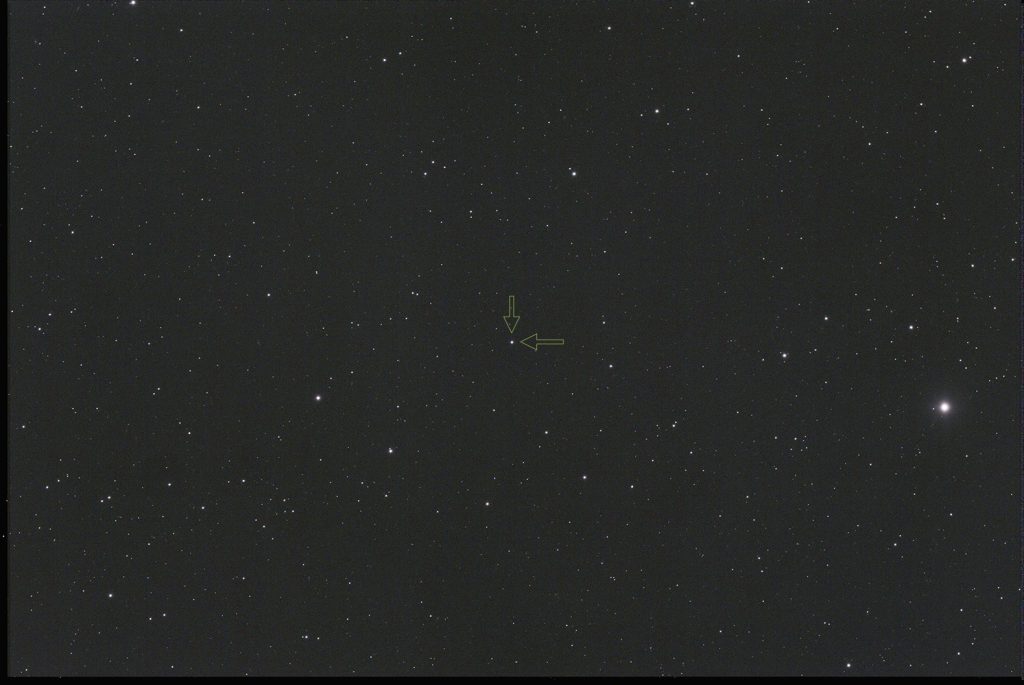
We wanted to get a photo of the star as a “before” image, so we hopped onto a remote dome and scope we’ve built for our state’s astronomical society. I was wondering if the trees around the dome were too high, but no, I got the shot. As you can see, the star (which is marked with arrows) is boringly dim. The bright star is Epsilon CrB, and during the event, our star will outshine this guy easily.
We’ll see if we can get another shot when it goes off.