PegasusAstro makes a large range of gadgets for astrophotographers. This includes power distribution and dew control, flat screens, filter wheels, dummy batteries, EQMOD and other cables and sensors. They even make harmonic mounts.
Apart from all of these products, Pegasus have bravely waded into the adapter production game. This is not for the faint hearted, as the number of adapters needed by our clients is, well, astronomical. If you look at our Pegasus Adapters webpage you’ll see there are lots, and there are more coming, including adapters for the Prodigy microfocuser. It never ends.
So the next question is how you can wade your way through all of these?
In general, Pegasus adapters’ product codes follow a pattern. After the “PEG-ADAPT” bit, there are two groups, showing what’s at each end of the adapter. Because Pegasus are the princes of the 54mm thread (others tend to top out at 48mm) a lot of the codes have “M54M”, which means a metric thread, 54mm in diameter, with the threads on the outside (a “male thread”, and I needn’t elaborate on why this is…).
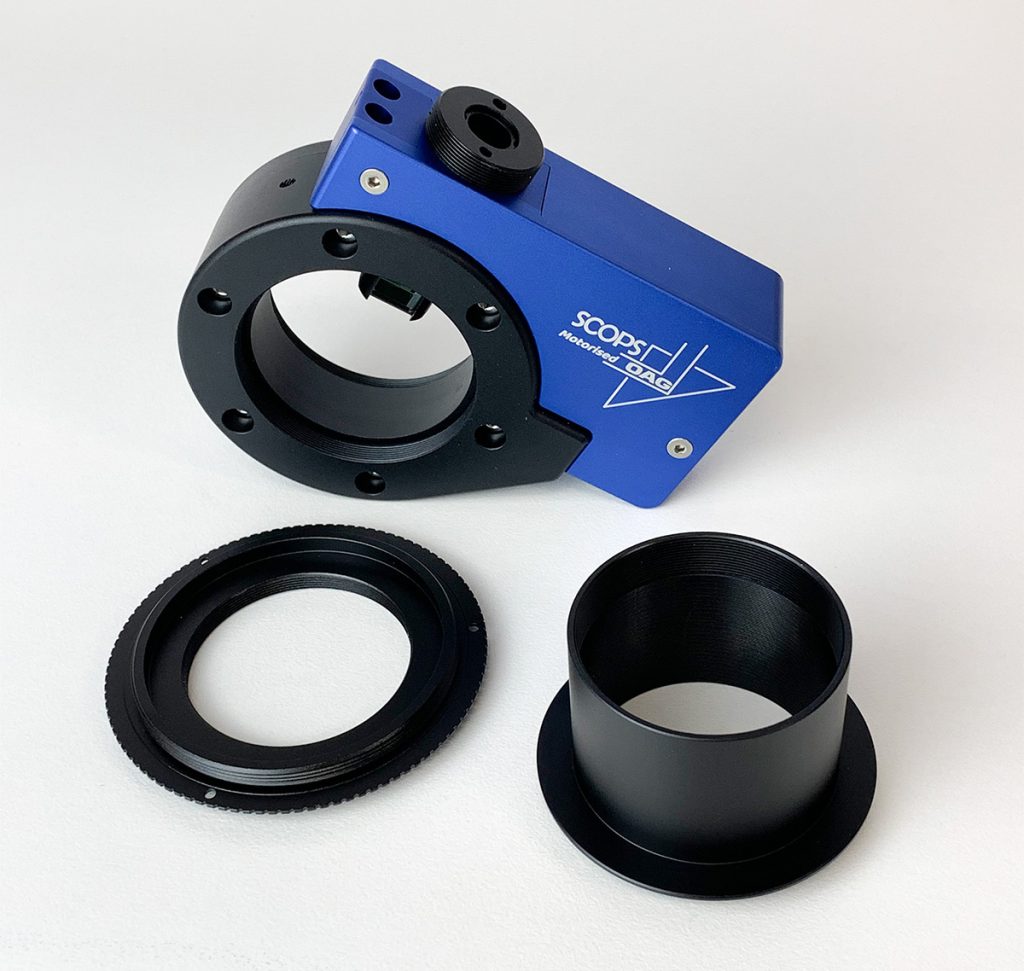
So, for the example on my desk here, the SCOPS automated off-axis guider has female M54 threads on both sides. If you want to put it onto a focuser with a 2-inch compression ring, you will need a 2-inch nosepiece with a 54mm male thread on the telescope side. That’s PEG-ADAPT-M54M-2NP. Then, if you had another component that has a 68mm female thread, you would need PEG-ADAPT-M68M-M54M.
One last observation. Murphy’s Law says that if you need a strange adapter, it won’t be available. With PegasusAstro adapters, Murphy is getting a bit more constrained, but you know he’ll try to find a way!