
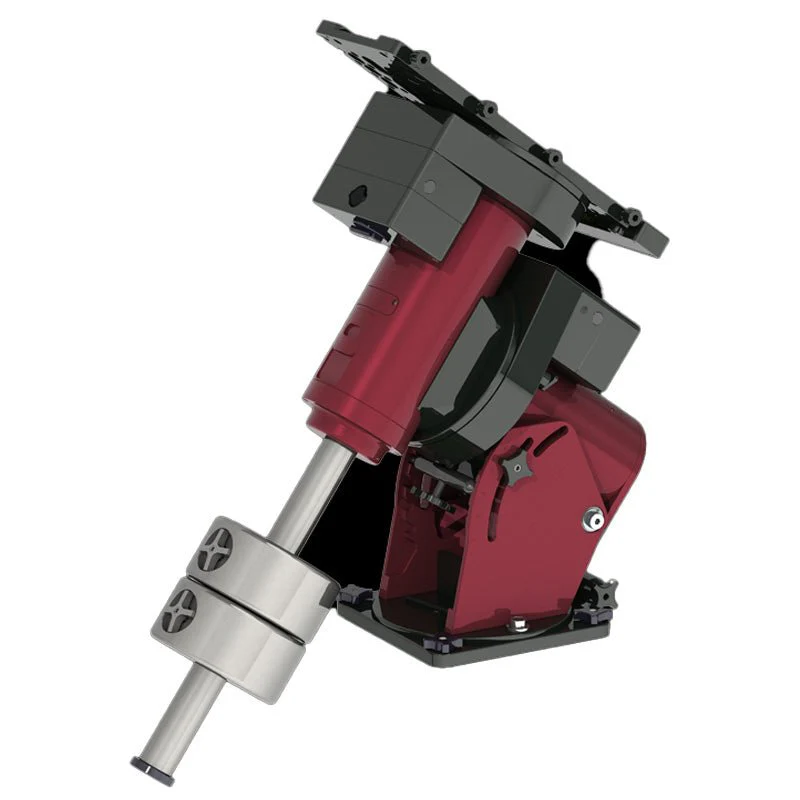
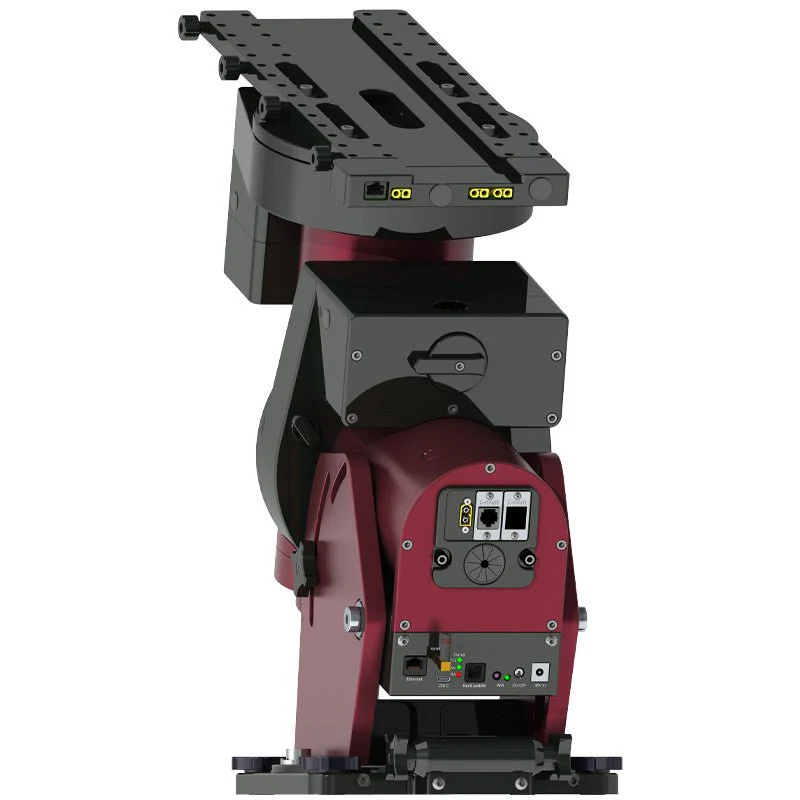
The Software Bisque Paramount MX Series 6 occupies the middle ground between the portable MYT and the observatory-focused ME. It is a heavy-duty, transportable German equatorial robotic mount designed for larger imaging systems, substantial telescope payloads, and users who require permanent-observatory-grade performance while still retaining a degree of portability. Software Bisque positions the MX as a transportable observatory-class mount, suited to demanding astrophotography rigs and advanced semi-permanent installations.
Increased Capacity for Larger Imaging Systems
The Paramount MX Series 6 supports an impressive 125 lb. / 56 kg instrument payload, with a maximum total payload capacity of 250 lb. / 113 kg when instruments and counterweights are included. The mount body weighs 54 lb. / 24 kg without the counterweight shaft or counterweights. For the Series 6 generation, Software Bisque states that the MX receives a 25% instrument capacity increase, which further improves its ability to support heavier refractors, larger corrected reflectors, medium-sized RC systems, astrographs, and multi-accessory imaging configurations.
High-Precision Mechanical Tracking
Like the MYT, the MX Series 6 uses belt-driven pulleys with spring-loaded worm gears, engineered to deliver virtually zero backlash. Software Bisque specifies:
- Maximum uncorrected periodic error: 7 arcseconds peak-to-peak
- Periodic error after training: typically 1 arcsecond peak-to-peak or less
This makes the MX suitable for high-resolution, long-exposure imaging with heavy optical systems, especially when paired with an accurate TPoint™ model and well-configured guiding or unguided workflows.
All-Sky Pointing Accuracy and Long Unguided Imaging Potential
The Paramount MX Series 6 is designed to achieve all-sky pointing accuracy at or below 30 arcseconds RMS through TPoint™ calibration and telescope modelling. Software Bisque states that 5- to 10-minute unguided exposures are common, with some users achieving up to 20 minutes under well-optimised conditions. This level of performance is especially valuable for automated imaging runs, remote observatories, and complex deep-sky projects where target acquisition and tracking reliability are critical.
Integrated Modelling with TPoint™ and ProTrack™
The MX is built around the same Software Bisque control ecosystem as the MYT and ME. TPoint™ builds a detailed pointing model from calibration samples, while ProTrack™ continuously corrects tracking position across both mount axes. Together, these tools help compensate for:
- Flexure in the telescope and imaging train
- Atmospheric refraction
- Polar misalignment
- Mechanical and harmonic tracking errors
- Slight encoder or gear centring variations
This is a core reason Software Bisque emphasises that absolute encoders are a valuable enhancement, but not a complete replacement for precision modelling.
Optional On-Axis Absolute Ring Encoders
The MX Series 6 is available with optional 26-bit Renishaw on-axis absolute encoders offering 0.02 arcsecond resolution and rated operation from -40°C to +80°C. These encoders provide significant operational benefits:
- No mount homing required
- No periodic error
- No backlash
- Faster precision pointing calibration
- Reduced number of TPoint™ samples required for advanced performance
Software Bisque notes that users can purchase the MX without encoders and arrange for factory retrofitting later if needed.
MKS 6000 Electronics and Modern Connectivity
The Paramount MX Series 6 includes the MKS 6000 telescope control system, which provides:
- USB-C connectivity
- Ethernet connectivity
- Wi-Fi connectivity
The mount also features three high-power XT60 power ports on the instrument panel, supporting more capable on-mount power distribution for modern imaging rigs. Software Bisque has clearly developed the Series 6 range with cable-heavy imaging systems in mind, and the MX offers ample internal space for running custom cables through the mount body.
Through-the-Mount Cabling
The telescope control system, motor cabling, power cabling, and electronics cabling are housed within the MX mount body to reduce cable exposure and snag risk. Additional room is provided for the user to route custom cables through the mount. This clean cabling approach supports more reliable remote imaging, especially during automated slews, meridian crossings, and multi-hour acquisition sequences.
Clutch-Free Operation and AutoHome™
The MX uses Software Bisque’s clutch-free design, which helps preserve the integrity of the TPoint™ pointing model. Since the mount does not rely on user-adjustable clutches that can shift the coordinate reference unexpectedly, pointing and repeatability remain more predictable. For non-absolute-encoder models, AutoHome™ allows the system to re-establish its positional reference after startup or power interruption, with the homing process generally taking a minute or less.
Supplied Counterweights and Hardware
The Paramount MX Series 6 includes two 20 lb. / 9 kg counterweights, enough to balance approximately 40-50 lb. / 18-22 kg of instrumentation. Heavier optical systems may require additional counterweights. It also includes:
- 48V DC power supply
- PC-to-mount USB and Ethernet cables
- Versa-Plate™ mounting system
- German equatorial mount body
- Integrated power and control architecture
- Access to TheSky™ Universal Bundle software package
TheSky™ Universal Bundle Included
The MX includes Software Bisque’s TheSky™ Universal Bundle, integrating the software environment required to operate the mount, build TPoint™ models, control imaging hardware, manage dome functions, and support weather-aware observatory workflows. The package includes:
- TheSky™ Professional
- TPoint™
- Cameras+
- Domes
- Weather
- Multi-OS+
The software operates on Windows, macOS, and Linux, and Software Bisque notes that the interface remains consistent across each supported platform.
Who the Paramount MX Series 6 Suits
The MX Series 6 is a powerful choice for:
- Advanced astrophotographers using heavier telescope systems
- Medium to large private observatories
- Institutions and educational facilities
- High-resolution imaging setups that demand both payload and precision
- Users who want stronger carrying capacity than the MYT, while retaining more transportability than the ME

Reviews
There are no reviews yet.