Equatorial mounts
The final group of machines here is equatorial mounts. These (or at least the “go-to” ones with motors) are pretty much the logical conclusion of development here. There are dozens of motorised equatorial mounts from a wide range of brands, (such as iOptron, Sky-Watcher, Celestron, Rainbow Astro, or Astro-Physics). These are the most comprehensive way to track the stars, but they tend to be used more with telescopes than cameras and lenses.
The way to get the best image is to have motors to move in both axes: not just right ascension, but also declination. This is what an equatorial mount does.
Like trackers and guiders, an equatorial mount continually moves its right ascension westwards to compensate for the Earth’s rotation. If the mount has an autoguide system, it can instruct the mount’s RA motor to speed up or slow down to compensate for inaccuracies in the mount’s rotation rate.
But in addition to trackers and guiders, an equatorial mount is able to move in declination axis as well. If the autoguide system detects that the mount is drifting north or south of the target, it can move the declination motor, switching north and south to follow the target.
Equatorial mounts still need to have good polar alignment because, while they can correct for mechanical or other deviations, poor polar alignment will cause field rotation, meaning the stars on the outside of the photo will rotate around the star in the centre of the frame. This is, incidentally, also the reason why alt-azimuth mounts are not suited for long exposure astrophotography.
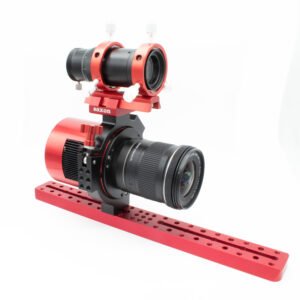
Finally, equatorial mounts have historically been large and heavy, but recently, astroequipment companies have been developing a range of very small full go-to equatorial mounts, such as the iOptron SkyHunter or the Sky-Watcher Star Adventurer GTi. These mounts are similar in size to sky trackers and guiders, and typically have the capacity for a camera and lens, or at most, a small refractor. That’s an iOptron SkyHunter on the right of the image at the top.